The best AI Bible chat app in 2026, in our view, is Bible Saga (we make it): every answer is grounded in Scripture with the verses cited, it follows the tradition you choose (Catholic, Protestant or Orthodox), your questions are not used to train the AI model, and the chat sits next to cinematic series of the Bible stories and the passage behind each one ($49.99 a year or $5.99 a week in the US). The most-rated alternatives in the US App Store are Bible Chat (about 366,000 ratings; $4.99 a week after a free trial), Haven (about 150,000 ratings; subscription required) and Creed (about 71,000 ratings; limited free use, AI voice). CrossTalk says it is always free, Logos adds an AI Study Assistant that answers only from its library of books, and Sacred Shorts includes unlimited AI Bible chat in its premium plan. Whatever app you use, check every answer against the verses it cites.
Asking an AI about the Bible has become one of the most common ways people now read it: “What does this verse mean?”, “Where does the Bible talk about anxiety?”, “Who was Nebuchadnezzar?”. A whole category of apps has grown around those questions, and the best of them do something a general chatbot does not: they keep the answer tied to the text.
We make one of these apps, Bible Saga, and it is our pick; we say why below. For the other apps, every rating, price and feature is taken from their own US App Store listings, checked on 15 October 2026. Prices change often, so check the listing before you subscribe.
The short answer
| App | What the AI does | Price (US) | Best for |
|---|---|---|---|
| 1. Bible Saga (our pick) | Answers questions from Scripture with citations, in your tradition, next to the passage and the episode | $5.99/week or $49.99/year, everything included | Understanding the stories you watch and read, with the verses in front of you |
| Bible Chat: Daily Devotional | Bible chat inside an all-in-one devotional app with prayer widgets and several translations | Free 7-day trial, then $4.99/week or longer plans | An everyday devotional companion |
| Haven – Bible Chat | Daily verses, devotionals, prayers, verse citations and “ask Haven anything” | Paid subscription required | Daily devotion with a question box |
| Creed: Bible Chat & Companion | “Lenny”, a Bible-based companion you can chat or talk with | Limited free use; subscription for unlimited chat and voice | Conversation and encouragement |
| CrossTalk: Bible Chat + Prayer | AI Bible assistant used as concordance, commentary or lexicon | Says it is always free | Free study questions |
| Logos Bible | Study Assistant that answers only from your Logos books | Free to try; subscription for more AI use | Serious study with commentaries |
| Sacred Shorts | AI Bible chat alongside cinematic Bible shorts and a Study Bible | $4.99/week or $34.99/year | Chat plus Bible videos |
Can you trust an AI about the Bible?
Partly, and only if you check it. AI models can quote a verse that does not exist, attach the right words to the wrong reference, or present one tradition’s reading as the only one. The safest apps reduce those risks by answering from the biblical text and showing their sources, but none removes them.
The Bible itself gives the right habit. When Paul preached in Berea, the people listened eagerly and then checked:
Now these were more noble than those in Thessalonica, in that they received the word with all readiness of mind, examining the Scriptures daily to see whether these things were so.
Acts 17:11 World English Bible
Use any AI Bible app the same way: read the cited verses in context, compare more than one translation, and bring the questions that matter most to a pastor, priest or a trusted group.
What to look for in an AI Bible app
- Citations in every answer. An answer without chapter and verse cannot be checked.
- The real text, one tap away. The best apps open the passage, not a paraphrase of it.
- Your tradition. Catholics, Protestants and Orthodox Christians answer some questions differently (on the saints, the sacraments, the books of the Bible); a good app knows which tradition you follow and says when traditions differ.
- Privacy. Questions about faith are personal. Check whether your conversations are used to train AI models.
- The price of the whole app. Many chat apps are weekly subscriptions; compare what you get for it.
The apps compared
1. Bible Saga: our top pick
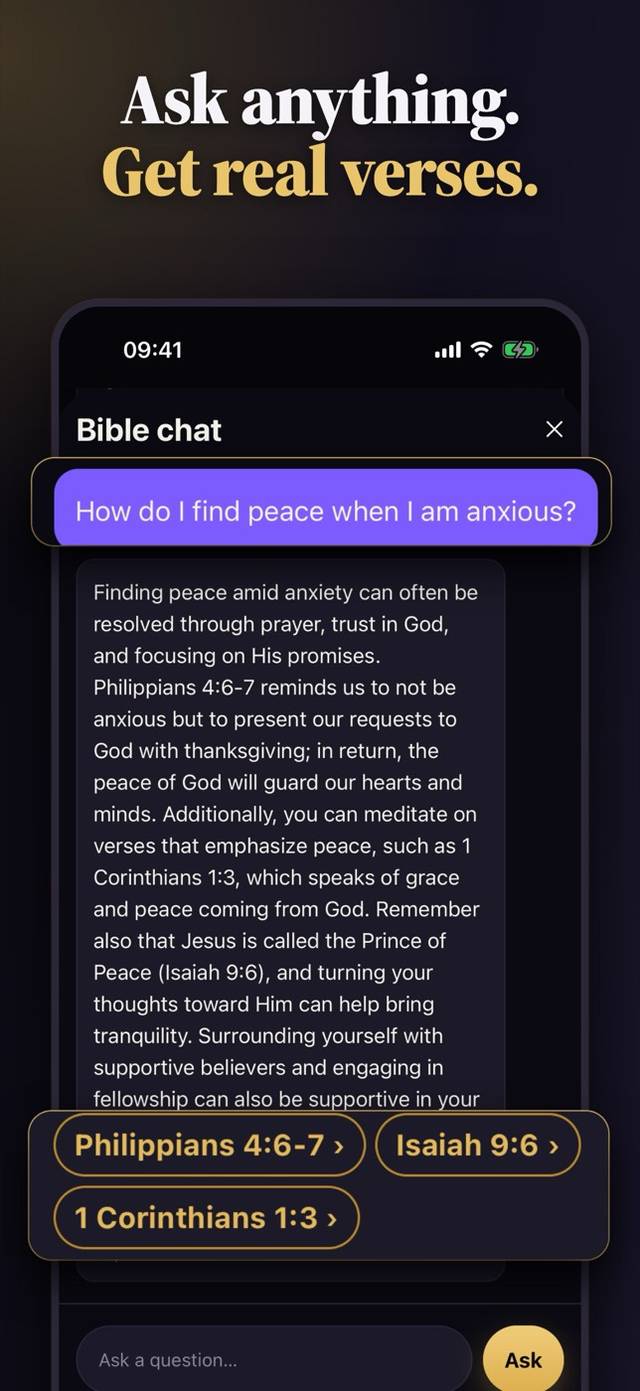
Bible Saga is our app. Its Scripture chat answers questions about any verse or story from the Bible itself, always with the references, so you can open the passage and read it. It knows which tradition you chose when you set up the app (Catholic, Protestant or Orthodox) and the language you use, and it is built into everything else the app does: cinematic series of the Bible stories (Daniel, Esther, Joseph, David and Goliath, Jonah), the passage behind each episode, a daily verse and a prayer.
Why it is our pick:
- Every answer cites Scripture, and the Bible is in the same app, in public-domain translations quoted word for word (World English Bible, King James Version, Berean Standard Bible and Douay-Rheims in English).
- It follows your tradition instead of giving one answer for every Christian.
- Your questions are not used to train the AI model, under our agreement with the provider, and the chat only runs after you allow it (privacy policy).
- It is more than a chat: you can watch the story you are asking about, from Daniel in the lions’ den to Jonah and the whale.
- You can report an answer you think is wrong, straight from the chat.
It costs $49.99 a year or $5.99 a week in the US, with every series and feature included, and there is no free tier. It is on Google Play now; the iPhone version is in App Store review as of October 2026.
Choose it if you want answers you can check, in your own tradition, next to the stories themselves.
2. Bible Chat: Daily Devotional
The most-rated app in this comparison, with an average of 4.9 from about 366,000 US ratings. It is an all-in-one devotional app: Bible reading in several translations (including NKJV, KJV, NASB and the World English Bible), prayer, a verse widget and an AI chat. It starts with a free 7-day trial, then $4.99 a week or longer plans, and it lists 17 languages.
Choose it if you want a large, established devotional app with many translations.
3. Haven – Bible Chat
Haven offers hand-picked daily verses, devotionals, prayers and “rich verse citations”, and you can “ask Haven anything”. It averages 4.9 from about 150,000 US ratings. Its listing states that access “requires a paid subscription”.
Choose it if you want a daily devotional routine with an AI you can ask questions.
4. Creed: Bible Chat & Companion
Creed presents its AI as “Lenny”, a “Bible-based friend” you can talk to, by text or by voice, with personalized prayers and devotionals. It averages 4.9 from about 71,000 US ratings. Free users get limited AI chat and voice; unlimited use needs a subscription.
Choose it if you want a conversational companion more than a study tool.
5. CrossTalk: Bible Chat + Prayer
CrossTalk describes itself as an AI-powered Bible assistant you can use as a concordance, commentary or lexicon, for readers who are “Reformed, Catholic, Protestant, or exploring Christianity”. It includes a verse of the day and a prayer wall, and its listing says it “is always free”. It averages 4.9 from about 4,700 US ratings.
Choose it if you want a free AI for study questions.
6. Logos Bible
Logos, from Faithlife, is a long-established Bible study platform with commentaries and theological libraries. Its AI Study Assistant answers questions with material “drawn only from your Logos books”, with limited free use and more through a subscription. It averages 4.9 from about 176,000 US ratings.
Choose it if you study seriously and want AI answers grounded in commentaries rather than a general model.
7. Sacred Shorts
Sacred Shorts combines cinematic Bible short films, a Study Bible, devotionals and guided prayer with an AI Bible chat, unlimited in its premium plan, at $4.99 a week or $34.99 a year in the US. See our full comparison of the best apps to watch Bible stories.
Choose it if you want chat and Bible videos in one subscription and new episodes every week.
Questions people ask AI Bible apps
The most useful questions are the ones that send you back to the text:
- “Where is this story in the Bible?” (for example, where David fights Goliath)
- “What does this verse mean in context?” (try it with “for such a time as this”)
- “What happened before and after this passage?”
- “How do Catholics and Protestants read this differently?”
- “What are the key verses about forgiveness?” (Joseph’s answer to his brothers is one; see Joseph and the coat of many colors)
Questions about personal crises, health or safety deserve a person, not only an app: a pastor, a counselor or, in an emergency, local emergency services.
Frequently asked questions
What is the best AI Bible app?
Our pick is Bible Saga (we make it): answers grounded in Scripture with citations, in your tradition, with your questions not used to train the AI, and the Bible stories as cinematic series in the same app. The most-rated alternatives in the US App Store are Bible Chat, Haven and Creed.
Is there a free AI Bible app?
CrossTalk says it is always free. Logos and Creed let you try their AI features for free with limits. Bible Chat offers a 7-day free trial. Haven requires a paid subscription, and Bible Saga requires a subscription for all its features.
Can AI explain the Bible accurately?
It can help, but it can also be wrong: AI models sometimes misquote verses or present one interpretation as the only one. Use apps that cite their sources, read the cited verses in context, and check important questions with a pastor or priest, like the Bereans who examined the Scriptures daily (Acts 17:11).
Which AI Bible app is best for Catholics?
Look for an app that knows your tradition. Bible Saga asks whether you are Catholic, Protestant or Orthodox and tailors chat answers and prayers to it, and includes the Douay-Rheims translation. CrossTalk says it serves Reformed, Catholic and Protestant readers.
Do AI Bible apps use my conversations to train AI?
It depends on the app; check its privacy policy. In Bible Saga, questions sent to the AI provider are not used to train its models under our agreement, and the chat only runs after you allow it.
What is the difference between an AI Bible app and ChatGPT?
A general chatbot answers from everything it has learned and may not cite a verse. AI Bible apps are designed to answer from Scripture, show references and keep you close to the text; some, like Bible Saga, also adapt to your church tradition.
Sources
- App Store (United States) listings, checked on 15 October 2026: Bible Chat: Daily Devotional; Haven – Bible Chat; Creed: Bible Chat & Companion; CrossTalk: Bible Chat + Prayer; Logos Bible; Sacred Shorts: Bible Videos.
- Bible Saga privacy policy and editorial standards.
- The Bible: Acts 17:11, quoted from the World English Bible (public domain).
