The best Bible stories for adults are the ones children’s Bibles soften or skip: Cain and Abel (Genesis 4), Abraham and Isaac (Genesis 22), Jacob wrestling with God (Genesis 32), Joseph forgiving his brothers (Genesis 37–50), Ruth and Naomi (Ruth 1), David and Bathsheba (2 Samuel 11–12), Elijah’s despair under the broom tree (1 Kings 19), Esther’s choice (Esther 4), Job’s suffering (Job 1–42), Jonah’s anger at God’s mercy (Jonah 4), the prodigal son (Luke 15), Peter’s denial (Luke 22) and the road to Damascus (Acts 9). Read as an adult, they are stories about failure, grief, ambition, family betrayal, doubt and forgiveness, told with an honesty that surprises people who last met them in Sunday school. This guide gives each story’s place in the Bible, a short summary, its key verse quoted word for word, and what it says to a grown-up reader.
Most of us met the Bible’s stories as children: a flannel board, a picture book, a cartoon. The versions we remember are short and tidy. The originals are not. They are full of people who lie, grieve, run away, sleep with the wrong person, argue with God and get a second chance anyway.
That is why so many adults are surprised when they go back to them. The story of Joseph is not about a colorful coat; it is about a family torn apart by favoritism and the long, painful work of forgiving your own brothers. Jonah is not about a fish; it is about a man who is angry that God forgives his enemies.
This guide collects twenty stories that read differently when you are grown up. For each one you get where it is, what actually happens, the key verse quoted word for word from the World English Bible, and why it matters to an adult reader. Where we have written a full guide to a story, or made it into a series in our app, Bible Saga, we link to it.
The 20 stories at a glance
| # | Story | Where in the Bible | What it is really about |
|---|---|---|---|
| 1 | Adam and Eve hide from God | Genesis 3 | Shame, and a God who comes looking |
| 2 | Cain and Abel | Genesis 4 | Envy, and responsibility for one another |
| 3 | Noah and the flood | Genesis 6–9 | Judgment, and a promise after disaster |
| 4 | Abraham and Isaac | Genesis 22 | Trust when obedience makes no sense |
| 5 | Jacob wrestles with God | Genesis 32 | A lifetime of scheming, and a limp |
| 6 | Joseph and his brothers | Genesis 37–50 | Betrayal, power and forgiveness |
| 7 | Moses at the burning bush | Exodus 3 | A reluctant leader and the name of God |
| 8 | The crossing of the Red Sea | Exodus 14 | Fear, and being told to stand still |
| 9 | Ruth and Naomi | Ruth 1–4 | Grief, loyalty and starting over |
| 10 | David and Goliath | 1 Samuel 17 | Courage that comes from faith |
| 11 | David and Bathsheba | 2 Samuel 11–12 | Power, abuse and confession |
| 12 | Elijah under the broom tree | 1 Kings 19 | Burnout, and a still small voice |
| 13 | Esther’s choice | Esther 4 | Risking your position for others |
| 14 | Daniel in the lions’ den | Daniel 6 | Integrity under pressure at work |
| 15 | Job | Job 1–42 | Suffering that has no explanation |
| 16 | Jonah and Nineveh | Jonah 1–4 | Resenting God’s mercy to others |
| 17 | The good Samaritan | Luke 10 | Who your neighbor is |
| 18 | The prodigal son | Luke 15 | Two lost sons and a running father |
| 19 | Peter’s denial and restoration | Luke 22; John 21 | Failing someone you love |
| 20 | The road to Damascus | Acts 9 | A complete change of direction |
Stories from the beginning: Genesis
1. Adam and Eve hide from God (Genesis 3)
After they eat from the forbidden tree, the first thing Adam and Eve do is hide. The first thing God does is ask a question:
Yahweh God called to the man, and said to him, “Where are you?”
Genesis 3:9 World English Bible
Why it reads differently as an adult: the story is less about an apple than about shame: covering up, blaming each other, blaming God. And it begins God’s long search for people who are hiding.
2. Cain and Abel (Genesis 4)
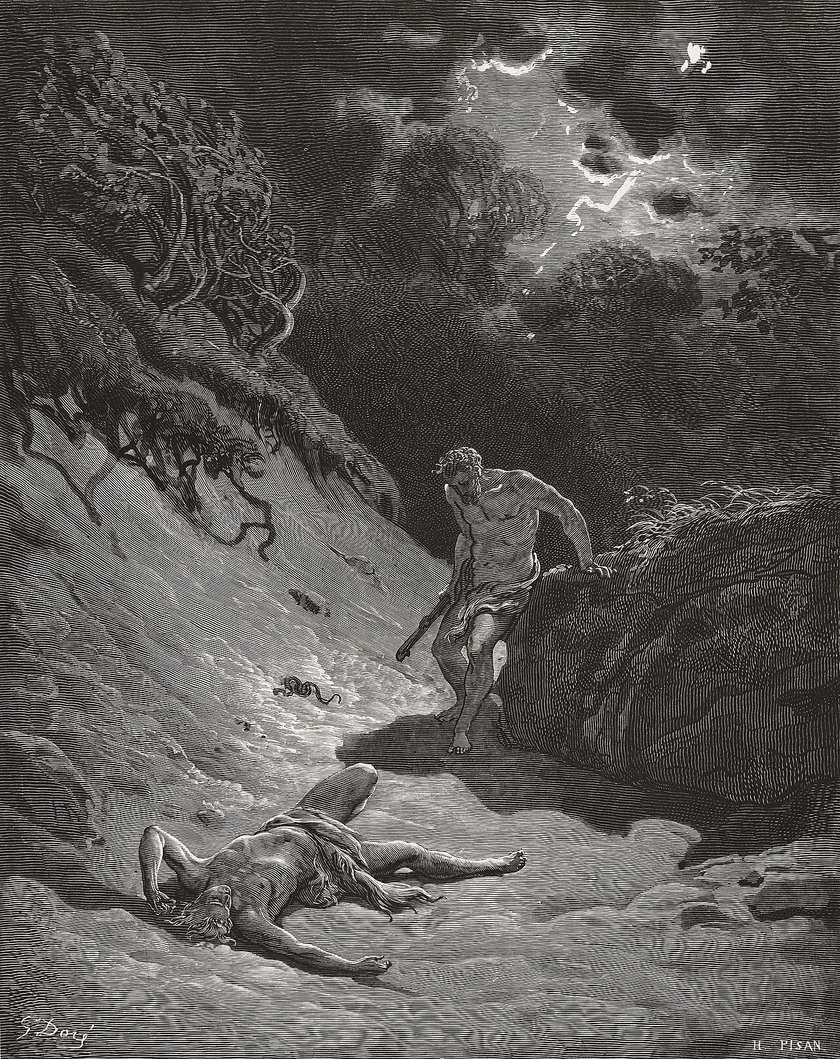
Cain’s offering is not accepted and his brother’s is. God warns him that “sin crouches at the door” (Genesis 4:7). Cain kills Abel anyway, and when God asks where his brother is, he answers with one of the most quoted lines in the Bible:
Yahweh said to Cain, “Where is Abel, your brother?” He said, “I don’t know. Am I my brother’s keeper?”
Genesis 4:9 World English Bible
As an adult: envy of a sibling or a colleague is not a children’s theme. Neither is the question the story leaves open: yes, we are responsible for each other.
3. Noah and the flood (Genesis 6–9)
The children’s version has smiling animals. The original is a story of violence filling the earth, a judgment, one family spared, and a new beginning with a promise:
I set my rainbow in the cloud, and it will be a sign of a covenant between me and the earth.
Genesis 9:13 World English Bible
As an adult: read it for what happens after the disaster: a God who binds himself by a promise never to destroy the earth by flood again (Genesis 9:11).
4. Abraham and Isaac (Genesis 22)
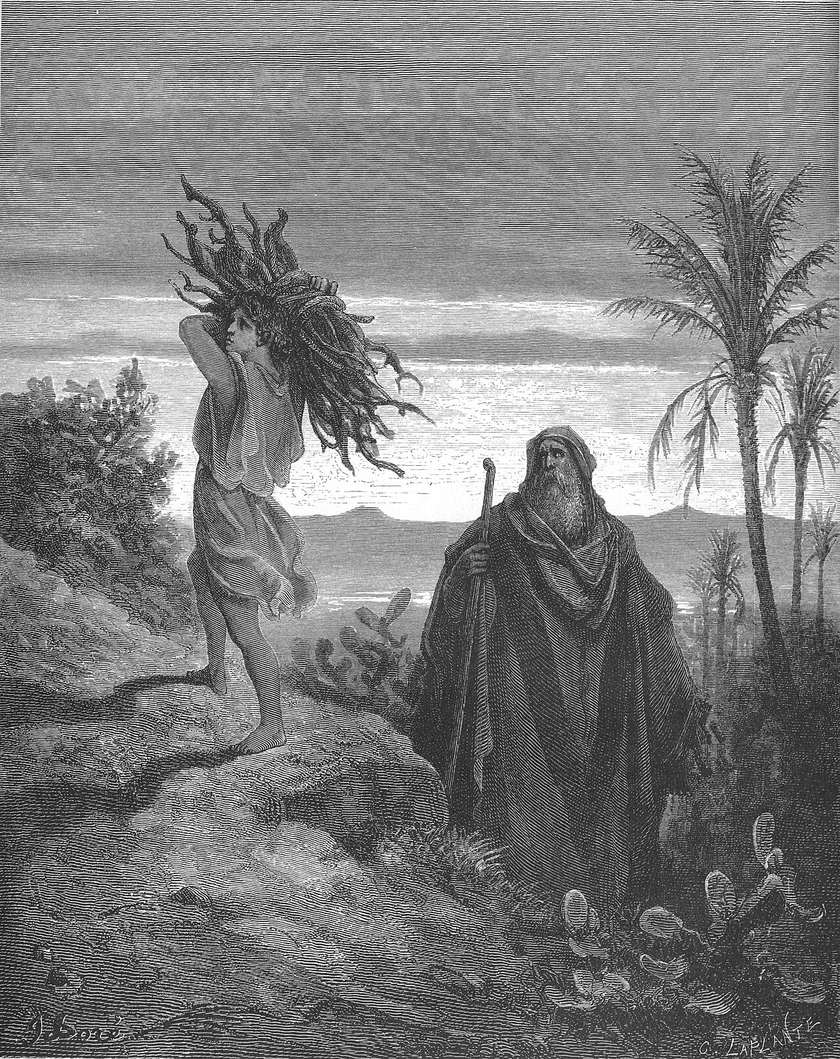
God tells Abraham to offer his son Isaac, the son he waited a lifetime for. It is one of the hardest chapters in Scripture to read as a parent. On the way up the mountain, the boy asks a question:
Isaac spoke to Abraham his father, and said, “My father?” He said, “Here I am, my son.” He said, “Here is the fire and the wood, but where is the lamb for a burnt offering?” Abraham said, “God will provide himself the lamb for a burnt offering, my son.” So they both went together.
Genesis 22:7-8 World English Bible
God stops Abraham’s hand and provides a ram. As an adult: the story does not explain the test away. It asks what it means to trust God with the thing you love most, and Christians have long read the provided lamb as pointing to Jesus.
5. Jacob wrestles with God (Genesis 32)
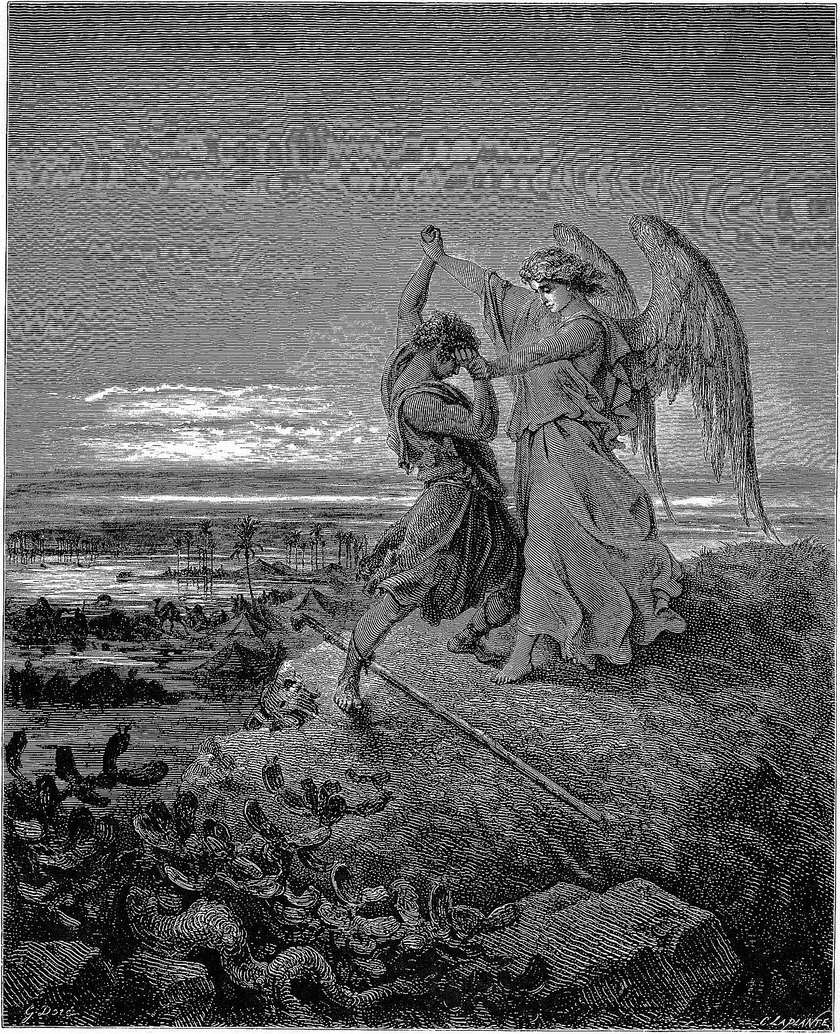
Jacob has spent his life getting ahead by tricks: his brother’s birthright, his father’s blessing. Alone at night before meeting the brother he cheated, he wrestles until dawn with a man who turns out to be God:
He said, “Your name will no longer be called Jacob, but Israel; for you have fought with God and with men, and have prevailed.”
Genesis 32:28 World English Bible
He leaves with a new name and a limp. As an adult: few stories describe so honestly what it is like to struggle with God and come away changed and wounded at the same time.
6. Joseph and his brothers (Genesis 37–50)
Favored by his father, hated by his brothers, Joseph is sold into slavery, falsely accused, forgotten in prison and finally raised to rule Egypt. When famine brings his brothers to him, he has every power to take revenge. He chooses something else:
As for you, you meant evil against me, but God meant it for good, to save many people alive, as is happening today.
Genesis 50:20 World English Bible
As an adult: this is the longest story in Genesis about a family, and its subject is forgiveness that takes years. Read the full story in our guide to Joseph and the coat of many colors.
Stories of the exodus
7. Moses at the burning bush (Exodus 3)
Moses is eighty, a fugitive, tending someone else’s sheep, when God calls him from a burning bush to go back to Egypt. He objects five times. When he asks God’s name, the answer is mysterious:
God said to Moses, “I AM WHO I AM,” and he said, “You shall tell the children of Israel this: ‘I AM has sent me to you.’ ”
Exodus 3:14 World English Bible
As an adult: God calls a man who thinks his life is over and who keeps listing reasons he is the wrong person.
8. The crossing of the Red Sea (Exodus 14)
Trapped between the sea and Pharaoh’s army, the people panic. Moses tells them not to act, but to wait:
Moses said to the people, “Don’t be afraid. Stand still, and see the salvation of Yahweh, which he will work for you today; for you will never again see the Egyptians whom you have seen today. Yahweh will fight for you, and you shall be still.”
Exodus 14:13-14 World English Bible
As an adult: “stand still” is hard advice for anyone who believes everything depends on them.
Stories of Israel’s judges and kings
9. Ruth and Naomi (Ruth 1–4)
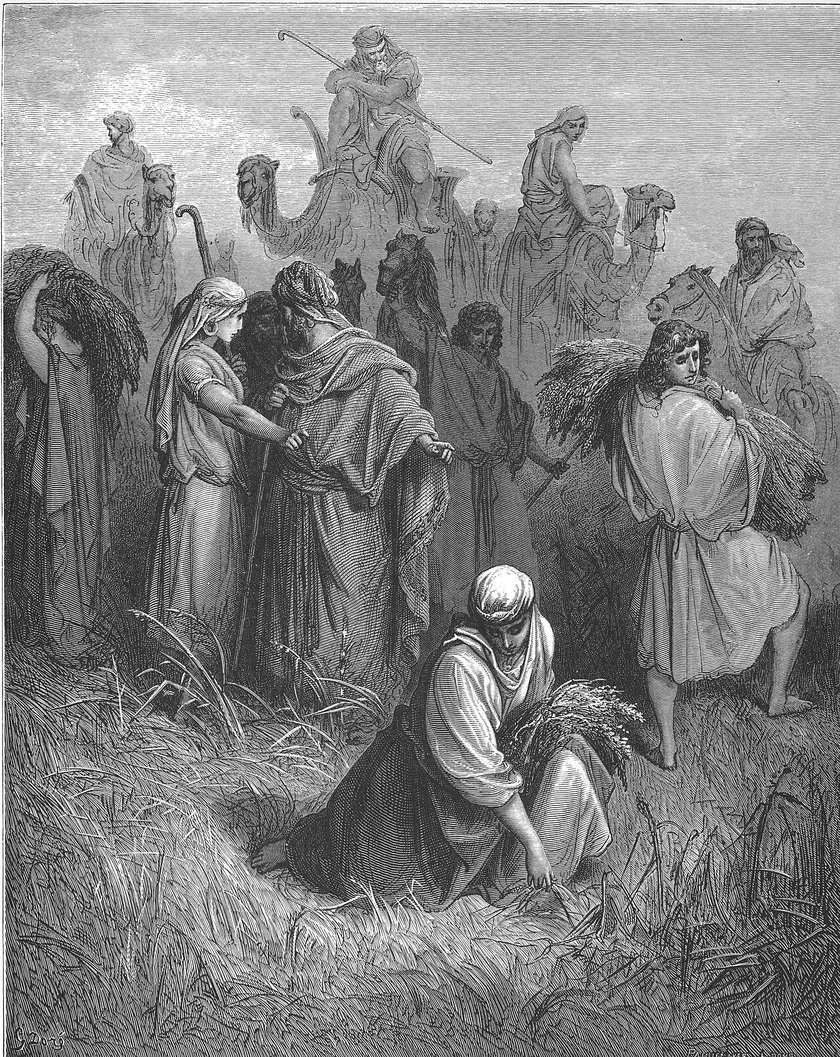
Naomi loses her husband and both sons in a foreign land and goes home bitter. Her daughter-in-law Ruth, a foreigner, refuses to leave her:
Ruth said, “Don’t urge me to leave you, and to return from following you, for where you go, I will go; and where you stay, I will stay. Your people will be my people, and your God my God.
Ruth 1:16 World English Bible
Ruth works in the fields, is noticed by Boaz, and becomes the great-grandmother of King David. As an adult: a quiet story about widowhood, immigration, loyalty and how a life is rebuilt after loss.
10. David and Goliath (1 Samuel 17)
A shepherd boy faces a giant the whole army fears, armed with a sling and the conviction that the battle belongs to God:
and that all this assembly may know that Yahweh doesn’t save with sword and spear; for the battle is Yahweh’s, and he will give you into our hand.”
1 Samuel 17:47 World English Bible
As an adult: the story is not about self-confidence; it is about seeing a problem in the light of God rather than measuring it against yourself. Our full guide covers David and Goliath, including how tall Goliath really was.
11. David and Bathsheba (2 Samuel 11–12)
The same David, now king, stays home from war, takes another man’s wife and arranges her husband’s death. The prophet Nathan tells him a story about a rich man who steals a poor man’s only lamb, and when David is outraged, Nathan turns it on him:
Nathan said to David, “You are the man. This is what Yahweh, the God of Israel, says: ‘I anointed you king over Israel, and I delivered you out of the hand of Saul.
2 Samuel 12:7 World English Bible
David’s answer is a confession, not an excuse:
David said to Nathan, “I have sinned against Yahweh.” Nathan said to David, “Yahweh also has put away your sin. You will not die.
2 Samuel 12:13 World English Bible
As an adult: an unflinching story about what power does to a good man, and about real repentance. Psalm 51 is traditionally linked to this moment.
12. Elijah under the broom tree (1 Kings 19)
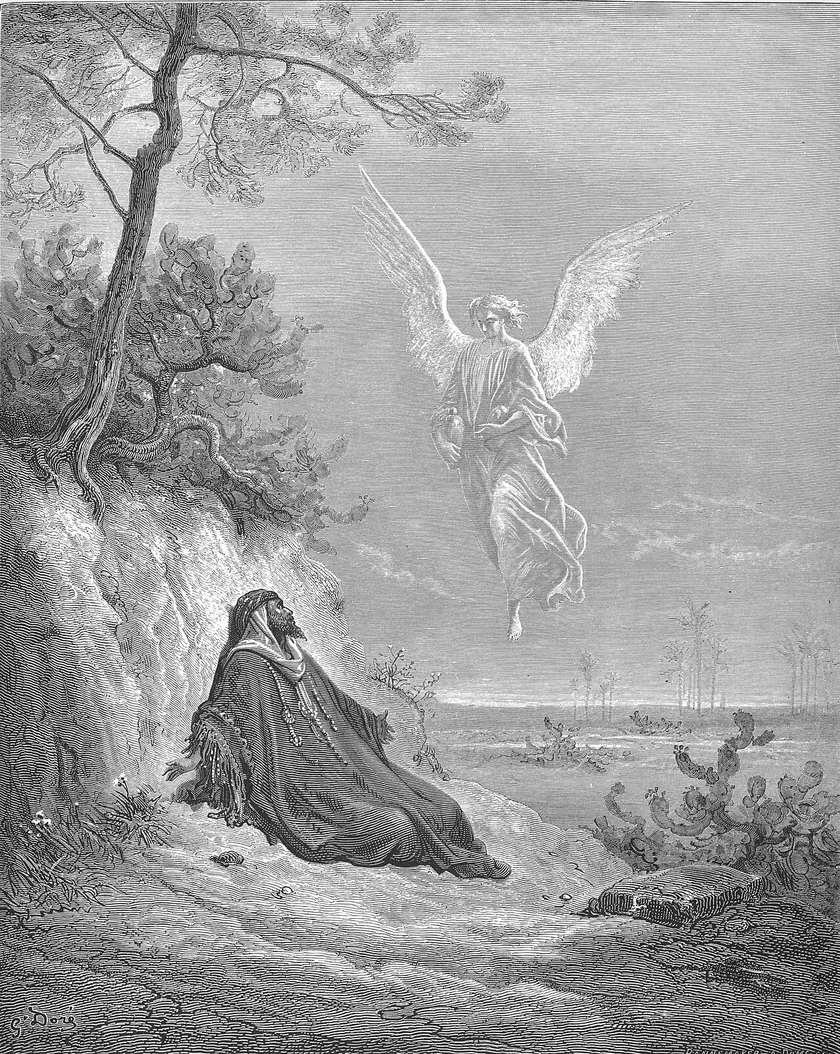
Right after his greatest victory on Mount Carmel, Elijah runs for his life, sits under a tree and asks to die. God sends food, then sleep, then meets him on the mountain, not in the wind, the earthquake or the fire:
He said, “Go out, and stand on the mountain before Yahweh.” Behold, Yahweh passed by, and a great and strong wind tore the mountains, and broke in pieces the rocks before Yahweh; but Yahweh was not in the wind. After the wind there was an earthquake; but Yahweh was not in the earthquake. After the earthquake a fire passed; but Yahweh was not in the fire. After the fire, there was a still small voice.
1 Kings 19:11-12 World English Bible
As an adult: one of the Bible’s clearest portraits of exhaustion and despair, and of a God who starts with rest and bread before he says anything.
Stories from exile
13. Esther’s choice (Esther 4)
A Jewish orphan has become queen of Persia, keeping her identity secret. When a decree orders the destruction of her people, her cousin Mordecai tells her she cannot stay safe and silent:
For if you remain silent now, then relief and deliverance will come to the Jews from another place, but you and your father’s house will perish. Who knows if you haven’t come to the kingdom for such a time as this?”
Esther 4:14 World English Bible
As an adult: a story about using a position you did not choose for people who have no voice. Read our guide to “for such a time as this”.
14. Daniel in the lions’ den (Daniel 6)
Daniel is an old man and a senior official when his rivals trap him with a law against prayer. He keeps praying at his open window, is thrown to the lions, and is found alive in the morning:
My God has sent his angel, and has shut the lions’ mouths, and they have not hurt me; because as before him innocence was found in me; and also before you, O king, I have done no harm.”
Daniel 6:22 World English Bible
As an adult: a story about integrity at work, and about faithfulness that does not change when the rules do. See our full guide to Daniel in the lions’ den.
Wisdom and the prophets
15. Job (Job 1–42)
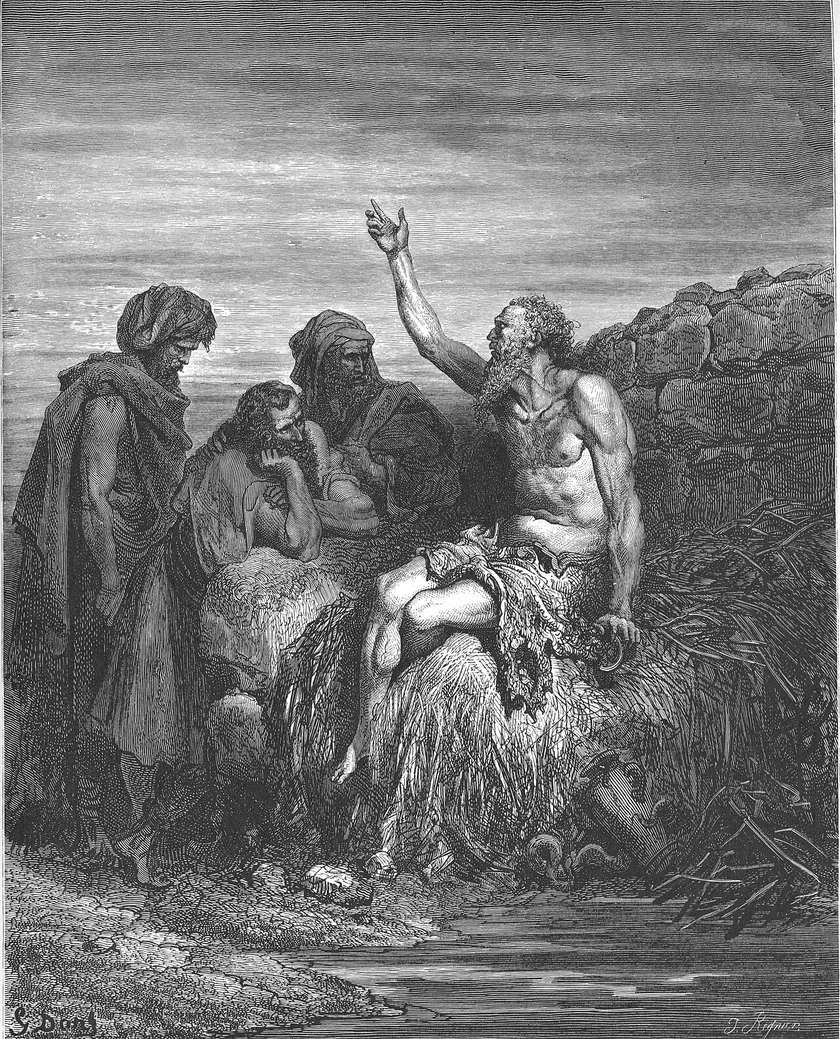
Job loses his children, his wealth and his health. His first response is worship:
He said, “Naked I came out of my mother’s womb, and naked will I return there. Yahweh gave, and Yahweh has taken away. Blessed be Yahweh’s name.”
Job 1:21 World English Bible
Then come thirty-five chapters of argument with friends who insist he must have deserved it, and finally God answers out of the whirlwind, not with an explanation but with questions:
“Where were you when I laid the foundations of the earth? Declare, if you have understanding.
Job 38:4 World English Bible
As an adult: Britannica calls the book’s theme “the eternal problem of unmerited suffering”. It refuses easy answers, and it never blames the sufferer.
16. Jonah and Nineveh (Jonah 1–4)
Jonah is sent to warn Nineveh, the capital of his nation’s enemy, runs the other way, ends up in the great fish, and finally preaches. The city repents and is spared, and Jonah is furious. He finally says why he ran:
He prayed to Yahweh, and said, “Please, Yahweh, wasn’t this what I said when I was still in my own country? Therefore I hurried to flee to Tarshish, for I knew that you are a gracious God, and merciful, slow to anger, and abundant in loving kindness, and you relent of doing harm.
Jonah 4:2 World English Bible
As an adult: the fish is the least important part. The story is about resenting grace when it is given to people we think do not deserve it. Read the whole book in our guide to Jonah and the whale.
Stories from the Gospels and Acts
17. The good Samaritan (Luke 10)
A lawyer asks Jesus who his neighbor is. Jesus tells of a man beaten and left on the road, ignored by a priest and a Levite and rescued by a Samaritan, a member of a despised group, then turns the question around:
Now which of these three do you think seemed to be a neighbor to him who fell among the robbers?” He said, “He who showed mercy on him.” Then Jesus said to him, “Go and do likewise.”
Luke 10:36-37 World English Bible
As an adult: the question shifts from “who deserves my help?” to “whose neighbor am I being?”
18. The prodigal son (Luke 15)
A younger son asks for his inheritance early, wastes it and comes home rehearsing a speech. He never gets to finish it:
“He arose, and came to his father. But while he was still far off, his father saw him, and was moved with compassion, and ran, and fell on his neck, and kissed him.
Luke 15:20 World English Bible
As an adult: read to the end. The parable has two lost sons, and the older brother, who never left home, is still standing outside the party when the story stops.
19. Peter’s denial and restoration (Luke 22; John 21)
Peter swore he would die for Jesus. Hours later, he denies knowing him three times:
The Lord turned and looked at Peter. Then Peter remembered the Lord’s word, how he said to him, “Before the rooster crows you will deny me three times.” He went out, and wept bitterly.
Luke 22:61-62 World English Bible
After the resurrection, Jesus asks him three times whether he loves him (readers have long noticed it is once for each denial) and gives him work to do:
He said to him the third time, “Simon, son of Jonah, do you have affection for me?” Peter was grieved because he asked him the third time, “Do you have affection for me?” He said to him, “Lord, you know everything. You know that I have affection for you.” Jesus said to him, “Feed my sheep.
John 21:17 World English Bible
As an adult: a story for anyone who has let down someone they love, and wonders if they can be trusted again.
20. The road to Damascus (Acts 9)
Saul is on his way to arrest Christians when a light knocks him to the ground:
He fell on the earth, and heard a voice saying to him, “Saul, Saul, why do you persecute me?” He said, “Who are you, Lord?” The Lord said, “I am Jesus, whom you are persecuting.
Acts 9:4-5 World English Bible
Blinded for three days, he is healed, baptized and becomes Paul, the apostle who wrote much of the New Testament. As an adult: proof in the Bible’s own pages that a life can turn around completely, even in the middle of a career built on the opposite.
How to read Bible stories as an adult
- Read the whole story, not the famous verse. Most of these stories are a few chapters long; reading them in one sitting changes how they feel.
- Notice what the story does not explain. The Bible often reports without commenting. The silence is part of the meaning.
- Ask where you are in the story. Not only the hero: also the older brother, the jealous sibling, the friend who gives bad advice.
- Read with someone. These stories were told aloud in communities long before they were read alone.
- Watch them. If reading is hard to fit into your day, a dramatized version can bring you back to the text. That is why we made Bible Saga.
Watch the stories as series
Bible Saga, our app, tells five of these stories as short cinematic series made for adults: Daniel, Esther, Joseph, David and Goliath and Jonah. Each episode is a few minutes long, the characters are introduced so the story makes sense even if you have not read it in years, and every quoted line of Scripture is word for word, with the passage one tap away. If you are choosing an app, see our comparison of the best apps to watch Bible stories.
Frequently asked questions
What are the best Bible stories for adults?
Stories that deal with adult experience: Cain and Abel (envy), Joseph and his brothers (betrayal and forgiveness), Ruth and Naomi (grief and loyalty), David and Bathsheba (power and confession), Elijah under the broom tree (burnout), Job (suffering), Jonah (resenting mercy), the prodigal son (two lost sons) and Peter’s denial (failure and restoration).
Are Bible stories only for children?
No. Children’s Bibles simplify the stories, and many leave out the hardest parts, such as David and Bathsheba or Job’s arguments with his friends. The original texts were written for adults and deal with violence, grief, sex, politics and doubt.
Where should an adult start reading Bible stories?
Start with a complete story you half remember, such as Joseph (Genesis 37–50) or Jonah (four short chapters), and read it in one sitting. Then try a Gospel, such as Luke, which contains the good Samaritan, the prodigal son and Peter’s denial.
What is the most powerful story in the Bible?
Christians would point to the death and resurrection of Jesus, told in all four Gospels. Among the other stories, readers often name Joseph forgiving his brothers (Genesis 50:20), the prodigal son (Luke 15) and Job, because of how honestly they deal with betrayal, forgiveness and suffering.
Is there a Bible story app for adults?
Yes. Bible Saga, our app, tells Bible stories as short cinematic series made for adults, with Scripture quoted word for word. Other apps that turn Bible stories into videos include BibleWatch, Sacred Shorts and Faithe; see our comparison of the best apps to watch Bible stories.
Which Bible translation is best for reading the stories?
Any reliable modern translation works. This guide quotes the World English Bible, a public-domain modern translation; the King James Version is the best-known traditional one. For stories, a readable translation you will actually finish matters more than which one you choose.
Sources
- The Bible: Genesis 3, 4, 9, 22, 32, 50; Exodus 3, 14; Ruth 1; 1 Samuel 17; 2 Samuel 12; 1 Kings 19; Esther 4; Daniel 6; Job 1, 38; Jonah 4; Luke 10, 15, 22; John 21; Acts 9, quoted from the World English Bible (public domain).
- “The Book of Job”, Encyclopaedia Britannica. britannica.com
- “David”, Encyclopaedia Britannica. britannica.com
