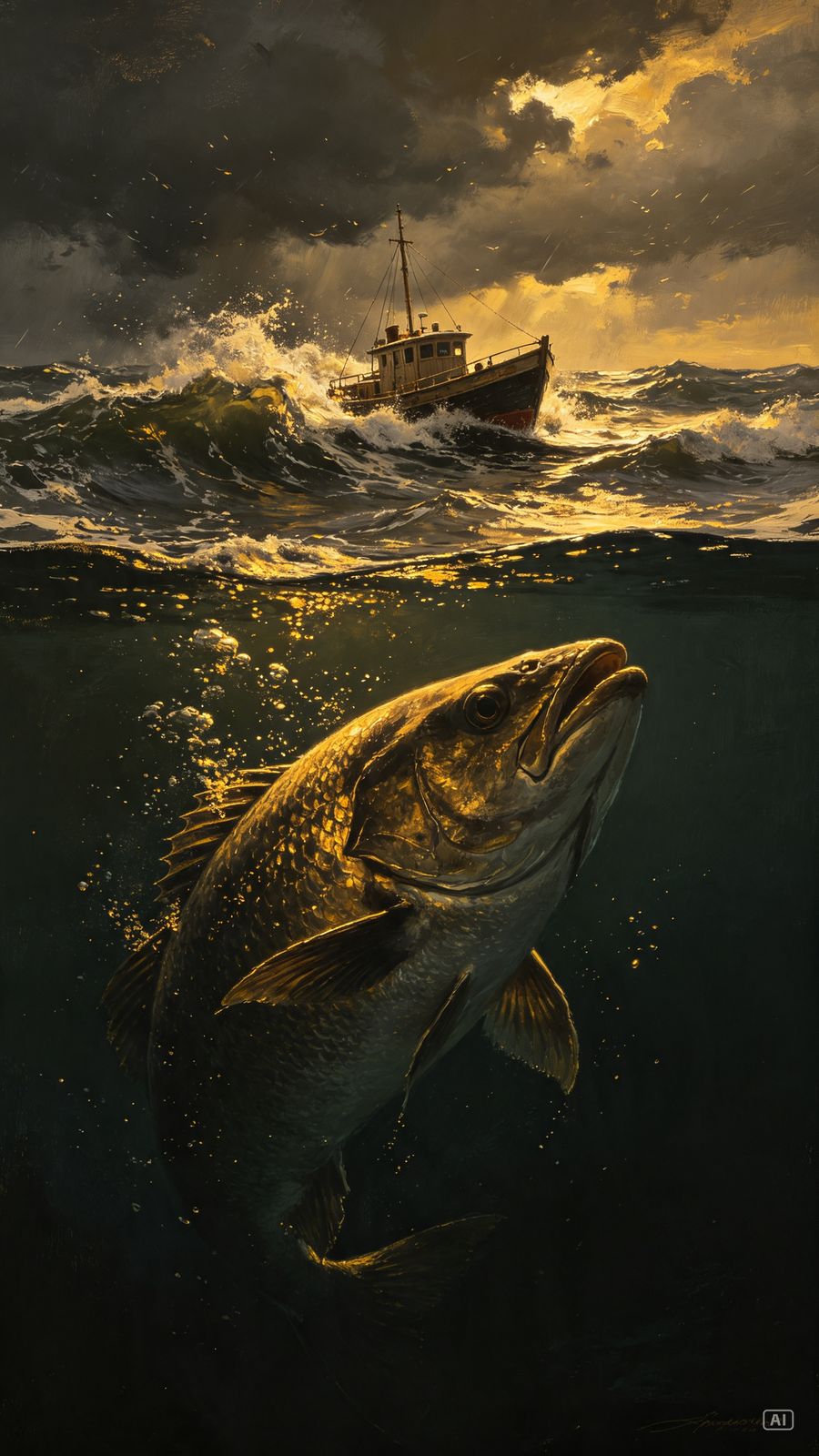
Jonah and the whale is the story told in the Book of Jonah, four short chapters in the Old Testament. God tells the prophet Jonah to go to Nineveh, the capital of Assyria and an enemy of Israel, and warn it of judgment. Jonah runs the other way and boards a ship for Tarshish. God sends a violent storm; the sailors throw Jonah overboard at his own request, and “Yahweh prepared a great fish to swallow up Jonah” (Jonah 1:17). After three days and three nights he prays from inside the fish and is thrown up on dry land. This time he goes to Nineveh, the whole city repents, and God spares it. The book ends with Jonah angry at God’s mercy and God asking him a question. The Hebrew text says “great fish”, not whale; “whale” comes from Jesus’ words about “the sign of Jonah” in Matthew 12:40.
Jonah and the whale is usually remembered as a children’s story about a man who gets swallowed by a fish. Read it through, and it turns out to be something sharper: the story of a prophet who knows exactly how merciful God is, and does not like it.
The whole book is only forty-eight verses long. This guide walks through all four chapters with the key verses quoted word for word from the World English Bible, looks at the history behind Nineveh, answers the question of the whale, and explains why Jesus called his own resurrection “the sign of Jonah”.
Where is Jonah and the whale in the Bible?
The story is the Book of Jonah, the fifth of the twelve Minor Prophets in the Old Testament. It has four chapters. The fish appears at the end of chapter 1 and in chapter 2; chapters 3 and 4 take place in and outside Nineveh.
Who was Jonah?
Jonah is not only a character in a story. He is mentioned in the history of Israel as a real prophet from the northern kingdom, who lived in the eighth century BC under King Jeroboam II:
He restored the border of Israel from the entrance of Hamath to the sea of the Arabah, according to Yahweh, the God of Israel’s word, which he spoke by his servant Jonah the son of Amittai, the prophet, who was from Gath Hepher.
2 Kings 14:25 World English Bible
Gath Hepher was a village in Galilee, near later Nazareth. Britannica notes what makes his book unique among the prophets: it is not a collection of his sermons but a story about him.
What was Nineveh?
Nineveh was the great capital of the Assyrian empire, on the east bank of the Tigris opposite modern Mosul in Iraq. It was at its height in the seventh century BC and was destroyed by the Babylonians and Medes in 612 BC (Britannica). For Israel, Assyria was the empire that would conquer and scatter the northern kingdom. Sending an Israelite prophet to save Nineveh is like asking someone to go and warn their worst enemy.
The story of Jonah and the whale, chapter by chapter
Chapter 1: God calls, Jonah runs
Now Yahweh’s word came to Jonah the son of Amittai, saying, “Arise, go to Nineveh, that great city, and preach against it, for their wickedness has come up before me.” But Jonah rose up to flee to Tarshish from the presence of Yahweh. He went down to Joppa, and found a ship going to Tarshish; so he paid its fare, and went down into it, to go with them to Tarshish from the presence of Yahweh.
Jonah 1:1-3 World English Bible
Tarshish was probably in the far west of the Mediterranean, the opposite direction from Nineveh. The text says it twice: Jonah was fleeing “from the presence of Yahweh”.
The storm
But Yahweh sent out a great wind on the sea, and there was a mighty storm on the sea, so that the ship was likely to break up. Then the mariners were afraid, and every man cried to his god. They threw the cargo that was in the ship into the sea to lighten the ship. But Jonah had gone down into the innermost parts of the ship, and he was laying down, and was fast asleep.
Jonah 1:4-5 World English Bible
The pagan sailors pray. The prophet of God sleeps in the hold. The captain has to wake him up and tell him to pray:
So the ship master came to him, and said to him, “What do you mean, sleeper? Arise, call on your God! Maybe your God will notice us, so that we won’t perish.”
Jonah 1:6 World English Bible
The lot falls on Jonah
The sailors cast lots to find out who is to blame, and the lot falls on Jonah. When they ask who he is, he answers with a confession of faith that condemns him:
He said to them, “I am a Hebrew, and I fear Yahweh, the God of heaven, who has made the sea and the dry land.” Then the men were exceedingly afraid, and said to him, “What have you done?” For the men knew that he was fleeing from the presence of Yahweh, because he had told them.
Jonah 1:9-10 World English Bible
“Throw me into the sea”
Then they said to him, “What shall we do to you, that the sea may be calm to us?” For the sea grew more and more stormy. He said to them, “Take me up, and throw me into the sea. Then the sea will be calm for you; for I know that because of me this great storm is on you.”
Jonah 1:11-12 World English Bible
The sailors do everything they can to avoid it. They row for shore, and when that fails they pray to Jonah’s God before they do what he asked:
Therefore they cried to Yahweh, and said, “We beg you, Yahweh, we beg you, don’t let us die for this man’s life, and don’t lay on us innocent blood; for you, Yahweh, have done as it pleased you.” So they took up Jonah, and threw him into the sea; and the sea ceased its raging. Then the men feared Yahweh exceedingly; and they offered a sacrifice to Yahweh, and made vows.
Jonah 1:14-16 World English Bible
By the end of the chapter, the sailors fear Yahweh and offer sacrifices. The runaway prophet has converted a ship full of pagans without meaning to.
The great fish
Yahweh prepared a great fish to swallow up Jonah, and Jonah was in the belly of the fish three days and three nights.
Jonah 1:17 World English Bible
In Hebrew Bibles this verse is numbered Jonah 2:1, so chapter 2 has one verse more there than in English Bibles. The fish is not a punishment in the story. It is how God rescues a man who was drowning.
Chapter 2: A prayer from the belly of the fish
Jonah’s prayer is a psalm of thanksgiving, prayed before he is out:
Then Jonah prayed to Yahweh, his God, out of the fish’s belly. He said, “I called because of my affliction to Yahweh. He answered me. Out of the belly of Sheol I cried. You heard my voice.
Jonah 2:1-2 World English Bible
The waters surrounded me, even to the soul. The deep was around me. The weeds were wrapped around my head. I went down to the bottoms of the mountains. The earth barred me in forever: yet have you brought up my life from the pit, Yahweh my God.
Jonah 2:5-6 World English Bible
It ends with the line many readers call the heart of the book:
But I will sacrifice to you with the voice of thanksgiving. I will pay that which I have vowed. Salvation belongs to Yahweh.” Then Yahweh spoke to the fish, and it vomited out Jonah on the dry land.
Jonah 2:9-10 World English Bible
Chapter 3: A second chance and a city that repents
Yahweh’s word came to Jonah the second time, saying, “Arise, go to Nineveh, that great city, and preach to it the message that I give you.”
Jonah 3:1-2 World English Bible
This time Jonah goes. His message is often called the shortest sermon in the Bible: five words in Hebrew.
Jonah began to enter into the city a day’s journey, and he cried out, and said, “In forty days, Nineveh will be overthrown!”
Jonah 3:4 World English Bible
The response is immediate and total, from the people to the king:
The people of Nineveh believed God; and they proclaimed a fast, and put on sackcloth, from their greatest even to their least. The news reached the king of Nineveh, and he arose from his throne, and took off his royal robe, covered himself with sackcloth, and sat in ashes.
Jonah 3:5-6 World English Bible
The king’s decree asks for exactly what the prophets asked of Israel, turning from violence and evil, and ends with a question:
Who knows whether God will not turn and relent, and turn away from his fierce anger, so that we might not perish?” God saw their works, that they turned from their evil way. God relented of the disaster which he said he would do to them, and he didn’t do it.
Jonah 3:9-10 World English Bible
Chapter 4: The angry prophet
This is where the story surprises most readers. Jonah is not relieved. He is furious, and he finally says why he ran:
But it displeased Jonah exceedingly, and he was angry. He prayed to Yahweh, and said, “Please, Yahweh, wasn’t this what I said when I was still in my own country? Therefore I hurried to flee to Tarshish, for I knew that you are a gracious God, and merciful, slow to anger, and abundant in loving kindness, and you relent of doing harm. Therefore now, Yahweh, take, I beg you, my life from me; for it is better for me to die than to live.”
Jonah 4:1-3 World English Bible
Jonah quotes back to God one of the oldest descriptions of God in the Bible (Exodus 34:6) as if it were an accusation. He did not run because he was afraid Nineveh would reject him. He ran because he knew it would repent and be forgiven.
The vine, the worm and a question
God answers with an object lesson. A plant grows overnight to shade Jonah, and the next morning a worm kills it:
Yahweh God prepared a vine, and made it to come up over Jonah, that it might be a shade over his head, to deliver him from his discomfort. So Jonah was exceedingly glad because of the vine. But God prepared a worm at dawn the next day, and it chewed on the vine, so that it withered. When the sun arose, God prepared a sultry east wind; and the sun beat on Jonah’s head, so that he fainted, and requested for himself that he might die, and said, “It is better for me to die than to live.”
Jonah 4:6-8 World English Bible
God said to Jonah, “Is it right for you to be angry about the vine?” He said, “I am right to be angry, even to death.” Yahweh said, “You have been concerned for the vine, for which you have not labored, neither made it grow; which came up in a night, and perished in a night. Shouldn’t I be concerned for Nineveh, that great city, in which are more than one hundred twenty thousand persons who can’t discern between their right hand and their left hand; and also much livestock?”
Jonah 4:9-11 World English Bible
The book ends on God’s question, with no answer from Jonah. It is left for the reader to answer.
Was it a whale or a great fish?
The Book of Jonah never says “whale”. The Hebrew in Jonah 1:17 is dag gadol, “a great fish”, and English Bibles translate it that way:
| Passage | Original word | World English Bible | King James Version |
|---|---|---|---|
| Jonah 1:17 (Hebrew) | dag gadol, great fish | “a great fish” | “a great fish” |
| Matthew 12:40 (Greek) | kētos, large sea creature | “the whale” | “the whale’s belly” |
The word “whale” comes from the Gospel of Matthew. The Greek kētos means a huge sea creature, and older English translators rendered it “whale”; the name stuck to the story. Either way, the text is not interested in zoology. It says God “prepared” the fish (Jonah 1:17), the same verb it later uses for the vine, the worm and the east wind: everything in creation obeys God in this book except his prophet.
The sign of Jonah: why Jesus talked about the whale
When some religious leaders asked Jesus for a miraculous sign, he pointed to Jonah:
But he answered them, “An evil and adulterous generation seeks after a sign, but no sign will be given to it but the sign of Jonah the prophet. For as Jonah was three days and three nights in the belly of the whale, so will the Son of Man be three days and three nights in the heart of the earth. The men of Nineveh will stand up in the judgment with this generation, and will condemn it, for they repented at the preaching of Jonah; and behold, someone greater than Jonah is here.
Matthew 12:39-41 World English Bible
Christians have read Jonah’s three days in the fish, and his return to the land of the living, as a pattern of Jesus’ death and resurrection. Luke’s version adds that Jonah himself “became a sign to the Ninevites” (Luke 11:30): a man who had come back from the deep.
What does the story of Jonah mean?
You cannot outrun God
Jonah goes down to Joppa, down into the ship, down into its hold, down into the sea. The book traces his descent step by step. God meets him at the bottom and brings him back up.
God’s mercy is bigger than our enemies
The sailors, the people of Nineveh, the king, even the animals: every outsider in this book turns to God. The only character who resists is the prophet. The story challenges anyone who thinks God’s mercy should stop at their own people.
Second chances are real
“Yahweh’s word came to Jonah the second time” (Jonah 3:1). God does not replace Jonah. He sends him again.
The last question is ours
God asks Jonah whether he should not care about a city of more than a hundred and twenty thousand people. The book stops there on purpose, so that every reader has to answer it.
How to read Jonah with a group or your family
- Where is your “Nineveh”: a person or group you would rather God did not forgive?
- The pagan sailors behave more faithfully than the prophet in chapter 1. Why do you think the story is told this way?
- Jonah prays a psalm of thanks while still inside the fish. What does it look like to thank God before the rescue is complete?
- Read Jonah 4:2 next to Exodus 34:6. How can the same truth comfort one person and anger another?
- How would you answer God’s question at the end of the book?
For children, the story fits in a few sentences: God asked Jonah to take a message to Nineveh, but Jonah ran away. After a big storm and a great fish, Jonah obeyed, the people said sorry, and God forgave them, because God loves everyone.
Watch the story of Jonah
Our series Jonah: The Runaway Prophet tells all four chapters in five short cinematic episodes, from the storm to the vine, with Scripture quoted word for word. It is coming soon to Bible Saga, our app; in the meantime you can watch Daniel in the lions’ den and read about Joseph and his coat of many colors.
Frequently asked questions
Where is the story of Jonah and the whale in the Bible?
In the Book of Jonah, one of the twelve Minor Prophets of the Old Testament. The great fish swallows Jonah in Jonah 1:17, he prays from inside it in Jonah 2, and it throws him up on dry land in Jonah 2:10.
Was it a whale or a big fish that swallowed Jonah?
The Book of Jonah says “a great fish” (Hebrew dag gadol). The word “whale” comes from Matthew 12:40, where Jesus refers to Jonah’s three days “in the belly of the whale”; the Greek word there, kētos, means a large sea creature.
How long was Jonah in the belly of the whale?
Three days and three nights (Jonah 1:17). Jesus compared this to the time the Son of Man would spend “in the heart of the earth” (Matthew 12:40).
Why did Jonah run away from God?
Jonah explains it himself in Jonah 4:2: he knew God was “a gracious God, and merciful, slow to anger, and abundant in loving kindness”, and he did not want Nineveh, the capital of Israel’s enemy Assyria, to be spared.
Did the people of Nineveh repent?
Yes. After Jonah proclaimed that Nineveh would be overthrown in forty days, the people believed God, fasted and put on sackcloth, and the king ordered everyone to turn from evil and violence. God saw it and did not bring the disaster (Jonah 3:5-10).
What is the sign of Jonah?
The phrase Jesus used when he was asked for a sign (Matthew 12:39-41; Luke 11:29-32). Just as Jonah was three days in the fish, Jesus would be three days in the tomb before rising: the one sign he would give.
Was Jonah a real person?
The Bible presents him as a historical prophet: 2 Kings 14:25 names Jonah son of Amittai from Gath Hepher, who prophesied under Jeroboam II in the eighth century BC. Christians and Jews have read the book in different ways, as history, as a teaching story, or both; its message does not depend on settling the question.
How does the Book of Jonah end?
With a question from God to Jonah: should God not be concerned for Nineveh, “in which are more than one hundred twenty thousand persons” (Jonah 4:11)? Jonah’s answer is never given.
Sources
- The Bible: Jonah 1–4, 2 Kings 14:25, Matthew 12:39-41 and Luke 11:30, quoted from the World English Bible (public domain); Matthew 12:40 also compared in the King James Version.
- “Jonah”, Encyclopaedia Britannica. britannica.com
- “Nineveh”, Encyclopaedia Britannica. britannica.com