David and Goliath is the story told in 1 Samuel 17. The armies of Israel and the Philistines face each other across the Valley of Elah, and for forty days a Philistine champion from Gath named Goliath challenges Israel to send one man to fight him. King Saul and his soldiers are terrified. David, the youngest son of Jesse of Bethlehem, a shepherd who has come only to bring food to his brothers, volunteers. He refuses Saul’s armor, picks up five smooth stones from a brook, and goes out with his sling, saying “the battle is Yahweh’s” (1 Samuel 17:47). His first stone strikes Goliath in the forehead; Goliath falls, and the Philistines run. The standard Hebrew text gives Goliath’s height as “six cubits and a span”, about 9 feet 9 inches; a Dead Sea Scroll and the ancient Greek translation say four cubits and a span, about 6 feet 9 inches.
David and Goliath has become a figure of speech: any underdog against any giant. But the story in the Bible is not really about a small person beating a big one. It is about a teenager who is the only person in a whole army who still believes that God is real and present, and about what happens when someone acts as if he is.
This guide walks through the story from the moment the prophet Samuel anoints David in his father’s house to the moment the giant falls, with the key verses quoted word for word from the World English Bible. It also answers the questions people search for most: how tall Goliath really was, how old David was, why he picked up five stones, and whether someone else killed Goliath.
Where is David and Goliath in the Bible?
The battle is in 1 Samuel 17, a long chapter of 58 verses in the Old Testament. The chapter before it, 1 Samuel 16, tells how David was secretly anointed as Israel’s future king, and it explains why the story matters. 1 Samuel 18 tells what the victory did to David’s life: it made him famous, and it made King Saul jealous.
Who was David?
David was the youngest of the eight sons of Jesse, a farmer of Bethlehem in the tribe of Judah. He looked after his father’s sheep. He would later become the second king of Israel, around 1000 BC, the king God called “a man after his own heart” (1 Samuel 13:14; see Acts 13:22) and the traditional author of many of the Psalms. Britannica notes that almost everything we know about him comes from the books of Samuel, and that the archaeological evidence for his kingdom is still debated by scholars.
Who was Goliath?
Goliath was a Philistine champion from Gath. The Philistines were a people of the coastal plain of Canaan, with five main cities: Gaza, Ashkelon, Ashdod, Ekron and Gath. In the days of Saul they were Israel’s most dangerous enemy, better armed and better organized. Gath has been excavated at Tell es-Safi in Israel by a team from Bar-Ilan University, and its walls and gates are real enough to measure (Science News).
Before the battle: God chooses the youngest son
The story really begins one chapter earlier. God has rejected Saul as king and sends the prophet Samuel to the house of Jesse to anoint one of his sons. Samuel sees the eldest, Eliab, tall and impressive, and is sure he has found the king. God stops him:
But Yahweh said to Samuel, “Don’t look on his face, or on the height of his stature, because I have rejected him; for I don’t see as man sees. For man looks at the outward appearance, but Yahweh looks at the heart.”
1 Samuel 16:7 World English Bible
Seven sons pass before Samuel, and none of them is chosen. Then Samuel asks if there is anyone else:
Samuel said to Jesse, “Are all your children here?” He said, “There remains yet the youngest. Behold, he is keeping the sheep.” Samuel said to Jesse, “Send and get him, for we will not sit down until he comes here.” He sent, and brought him in. Now he was ruddy, with a handsome face and good appearance. Yahweh said, “Arise! Anoint him, for this is he.” Then Samuel took the horn of oil, and anointed him in the middle of his brothers. Then Yahweh’s Spirit came mightily on David from that day forward. So Samuel rose up and went to Ramah.
1 Samuel 16:11-13 World English Bible
Soon afterwards David is brought to Saul’s court to play the harp for the troubled king (1 Samuel 16:14-23). But the anointing is the key to everything that happens in the valley. Before David ever faces a giant, the Bible has already told us that God does not judge by height. When David walks onto the battlefield, the reader knows something no one in either army knows: the shepherd is Israel’s anointed king.
The story of David and Goliath, step by step
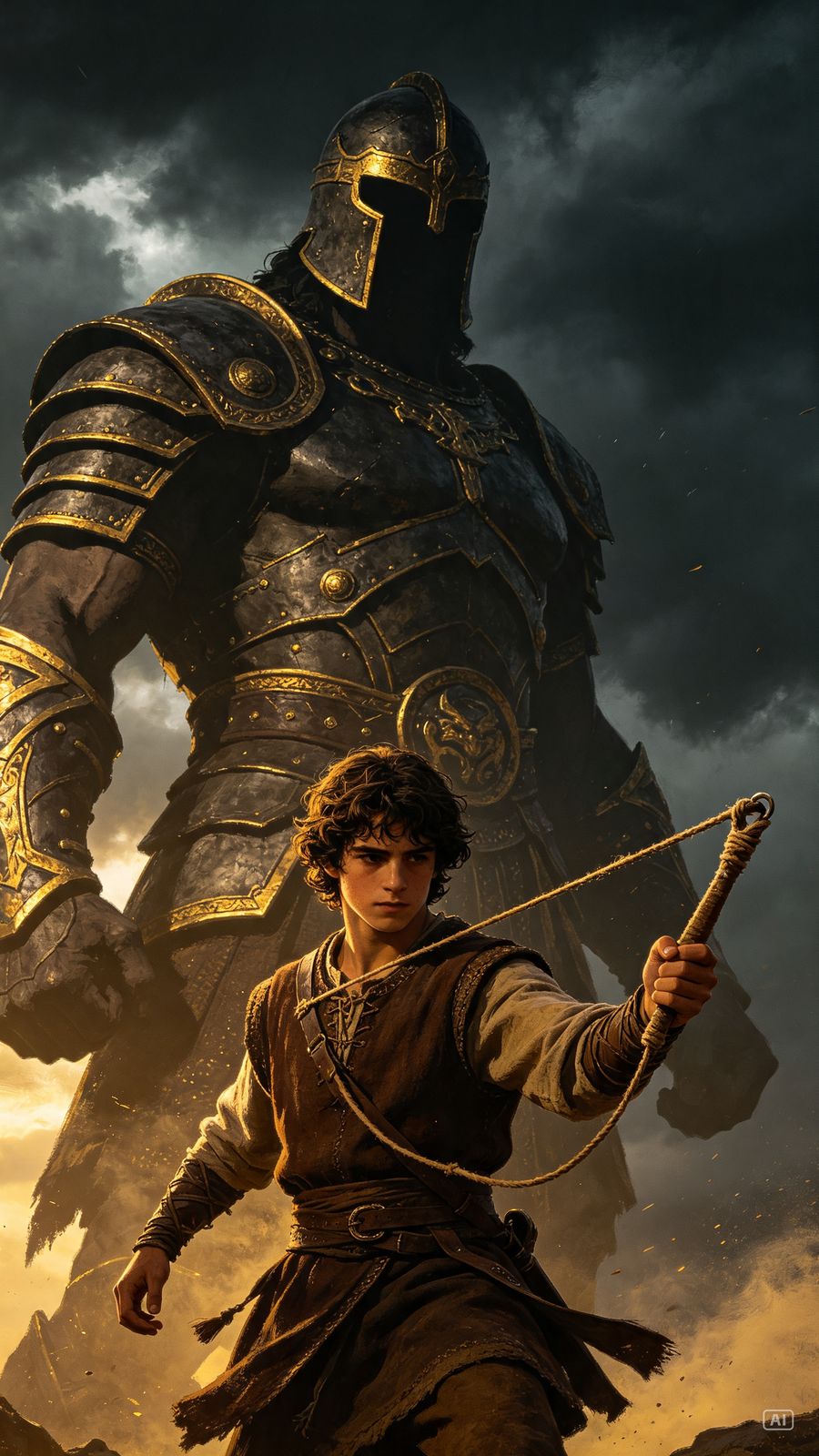
1. Two armies and a valley
Now the Philistines gathered together their armies to battle; and they were gathered together at Socoh, which belongs to Judah, and encamped between Socoh and Azekah, in Ephesdammim. Saul and the men of Israel were gathered together, and encamped in the valley of Elah, and set the battle in array against the Philistines. The Philistines stood on the mountain on the one side, and Israel stood on the mountain on the other side: and there was a valley between them.
1 Samuel 17:1-3 World English Bible
The Valley of Elah lies in the low hills west of Bethlehem, between the hill country of Judah and the Philistine plain. It was one of the routes from Philistine territory up into Israel’s hills. Neither army wants to attack across the valley floor, so they wait.
2. The champion from Gath
Then a single warrior walks out:
A champion out of the camp of the Philistines named Goliath, of Gath, whose height was six cubits and a span went out. He had a helmet of bronze on his head, and he wore a coat of mail; and the weight of the coat was five thousand shekels of bronze. He had bronze shin armor on his legs, and a bronze javelin between his shoulders. The staff of his spear was like a weaver’s beam; and his spear’s head weighed six hundred shekels of iron. His shield bearer went before him.
1 Samuel 17:4-7 World English Bible
The text spends four verses on his equipment, more than on anything else in the chapter. Bronze helmet, coat of mail of five thousand shekels (roughly 125 pounds; the weight of a shekel varied), bronze leg armor, a javelin, a spear with an iron head of six hundred shekels (roughly 15 pounds), and a man walking in front of him to carry his shield. Everything about Goliath says the same thing: this is a battle that will be won by size and metal.
3. The challenge
He stood and cried to the armies of Israel, and said to them, “Why have you come out to set your battle in array? Am I not a Philistine, and you servants to Saul? Choose a man for yourselves, and let him come down to me. If he is able to fight with me and kill me, then will we be your servants; but if I prevail against him and kill him, then you will be our servants and serve us.” The Philistine said, “I defy the armies of Israel today! Give me a man, that we may fight together!”
1 Samuel 17:8-10 World English Bible
Goliath proposes a duel between champions: one man from each side, and the losing nation serves the winner. It is a challenge Israel cannot accept, because no one dares to fight him:
When Saul and all Israel heard those words of the Philistine, they were dismayed, and greatly afraid.
1 Samuel 17:11 World English Bible
The text adds that this went on “morning and evening” for “forty days” (1 Samuel 17:16). Every day, the army of Israel listens to the same insult and does nothing.
4. A shepherd brings bread and cheese
David is not a soldier. His three oldest brothers are in the army; he goes back and forth between Saul’s court and his father’s sheep. Jesse sends him to the front with grain, bread and cheese, and to bring back news of his brothers. He arrives just as Goliath steps out again, and he sees the whole army run. His reaction is different from everyone else’s:
David spoke to the men who stood by him, saying, “What shall be done to the man who kills this Philistine, and takes away the reproach from Israel? For who is this uncircumcised Philistine, that he should defy the armies of the living God?”
1 Samuel 17:26 World English Bible
Notice how David names the giant’s crime. Goliath has not defied Saul, or Israel. He has defied “the armies of the living God”. That phrase is the whole difference between David and the soldiers around him.
5. Eliab’s anger
His oldest brother, the one Samuel had thought looked like a king, is furious:
Eliab his oldest brother heard when he spoke to the men; and Eliab’s anger burned against David, and he said, “Why have you come down? With whom have you left those few sheep in the wilderness? I know your pride, and the naughtiness of your heart; for you have come down that you might see the battle.” David said, “What have I now done? Is there not a cause?”
1 Samuel 17:28-29 World English Bible
It is a very human moment. The brother who was passed over for the anointing now treats the youngest as an arrogant child who has come to watch. David answers with a question and keeps going.
6. “Your servant will go and fight”
David’s words reach King Saul, who sends for him:
David said to Saul, “Let no man’s heart fail because of him. Your servant will go and fight with this Philistine.” Saul said to David, “You are not able to go against this Philistine to fight with him; for you are but a youth, and he a man of war from his youth.”
1 Samuel 17:32-33 World English Bible
David answers with the only experience he has, and it turns out to be the right one:
David said to Saul, “Your servant was keeping his father’s sheep; and when a lion or a bear came, and took a lamb out of the flock, I went out after him, and struck him, and rescued it out of his mouth. When he arose against me, I caught him by his beard, and struck him, and killed him. Your servant struck both the lion and the bear. This uncircumcised Philistine shall be as one of them, since he has defied the armies of the living God.” David said, “Yahweh who delivered me out of the paw of the lion, and out of the paw of the bear, he will deliver me out of the hand of this Philistine.” Saul said to David, “Go! Yahweh will be with you.”
1 Samuel 17:34-37 World English Bible
David is not boasting about his strength. His argument is about God: the same Lord who delivered him from the lion and the bear will deliver him from the Philistine.
7. Saul’s armor
Saul tries to help in the only way he knows. He dresses David in his own armor:
Saul dressed David with his clothing. He put a helmet of bronze on his head, and he clad him with a coat of mail. David strapped his sword on his clothing, and he tried to move; for he had not tested it. David said to Saul, “I can’t go with these; for I have not tested them.” Then David took them off.
1 Samuel 17:38-39 World English Bible
The king of Israel, who was himself taller than anyone in Israel from the shoulders up (1 Samuel 9:2), stays in his tent and lends his armor to a boy. David cannot even walk in it. He goes out as what he is.
8. Five smooth stones
He took his staff in his hand, and chose for himself five smooth stones out of the brook, and put them in the pouch of his shepherd’s bag which he had. His sling was in his hand; and he came near to the Philistine.
1 Samuel 17:40 World English Bible
A sling in the ancient world was not a toy. It was a weapon of war, a leather pouch on two cords that could throw a stone with great speed and accuracy; elsewhere the Bible mentions an army unit of left-handed slingers who “could sling a stone at a hair and not miss” (Judges 20:16).
9. What David said to Goliath
Goliath looks at David and is insulted:
When the Philistine looked around, and saw David, he disdained him; for he was but a youth, and ruddy, and had a good looking face. The Philistine said to David, “Am I a dog, that you come to me with sticks?” The Philistine cursed David by his gods. The Philistine said to David, “Come to me, and I will give your flesh to the birds of the sky, and to the animals of the field.”
1 Samuel 17:42-44 World English Bible
David’s answer is the heart of the chapter and one of the most quoted speeches in the Old Testament:
Then David said to the Philistine, “You come to me with a sword, with a spear, and with a javelin; but I come to you in the name of Yahweh of Armies, the God of the armies of Israel, whom you have defied. Today, Yahweh will deliver you into my hand. I will strike you, and take your head from off you. I will give the dead bodies of the army of the Philistines today to the birds of the sky, and to the wild animals of the earth; that all the earth may know that there is a God in Israel, and that all this assembly may know that Yahweh doesn’t save with sword and spear; for the battle is Yahweh’s, and he will give you into our hand.”
1 Samuel 17:45-47 World English Bible
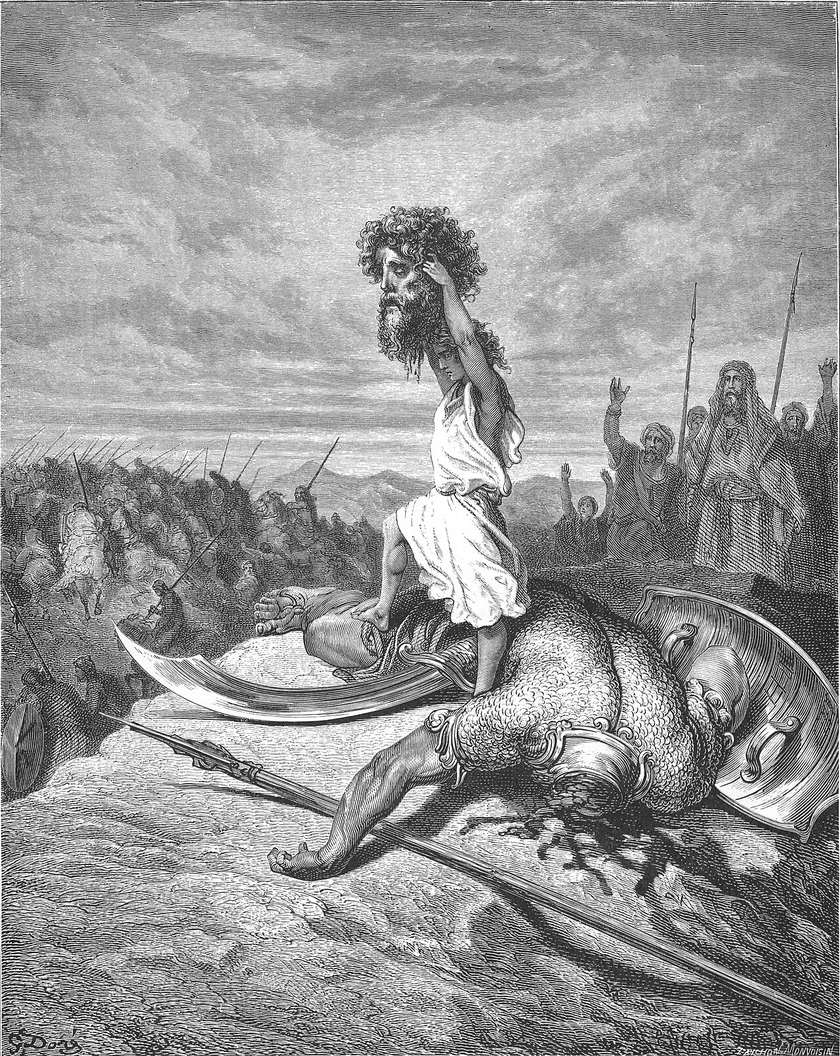
10. The stone and the sword
When the Philistine arose, and walked and came near to meet David, David hurried, and ran toward the army to meet the Philistine. David put his hand in his bag, took a stone, and slung it, and struck the Philistine in his forehead. The stone sank into his forehead, and he fell on his face to the earth. So David prevailed over the Philistine with a sling and with a stone, and struck the Philistine, and killed him; but there was no sword in the hand of David.
1 Samuel 17:48-50 World English Bible
Then David runs to the fallen giant, takes Goliath’s own sword and finishes the fight with it (1 Samuel 17:51). The narrator points out the irony twice: “there was no sword in the hand of David”. The Philistines see their champion dead and flee, and Israel chases them back to the gates of Gath and Ekron.
11. After the victory
The chapter ends with Saul asking whose son this young man is. The victory changes David’s life. He joins Saul’s court, becomes the closest friend of Saul’s son Jonathan, and wins a reputation that soon becomes dangerous:
The women sang to one another as they played, and said, “Saul has slain his thousands, and David his ten thousands.”
1 Samuel 18:7 World English Bible
Saul hears the song and becomes jealous. The rest of 1 Samuel is the story of a king hunting the young man God has chosen to replace him.
How tall was Goliath?
This is the most searched question about the story, and the honest answer is that ancient manuscripts disagree.
The standard Hebrew text, which the World English Bible and the King James Version translate, says “six cubits and a span”:
And there went out a champion out of the camp of the Philistines, named Goliath, of Gath, whose height was six cubits and a span.
1 Samuel 17:4 King James Version
But several older witnesses read four cubits and a span: the Greek Septuagint translation, one of the Dead Sea Scrolls of Samuel, and the first-century historian Josephus (Britannica). Some modern translations, such as the New Revised Standard Version, follow that reading.
| Source | Reading | Approximate height |
|---|---|---|
| Masoretic Hebrew text (KJV, WEB) | six cubits and a span | about 9 ft 9 in (2.97 m) |
| Septuagint, Dead Sea Scroll of Samuel, Josephus (NRSV) | four cubits and a span | about 6 ft 9 in (2.06 m) |
The conversions use a cubit of about 18 inches and a span of half a cubit. The length of a cubit varied in the ancient world, so these are estimates either way. The Old Testament scholar J. Daniel Hays argued in the Journal of the Evangelical Theological Society that the shorter reading is probably the original one (Hays, 2005). In 2020, the archaeologist Jeffrey Chadwick of Brigham Young University reported that a gateway excavated at Gath is four cubits and a span wide by the cubit its builders used, about 7 feet 10 inches, and suggested the phrase may have been a way of saying Goliath was as big and strong as the walls of his city (Science News).
Either way, Goliath was far taller than the soldiers around him, and carrying armor that would have crushed most men. The point of the story does not change: God looks at the heart, not at “the height of his stature” (1 Samuel 16:7).
How old was David when he fought Goliath?
The Bible does not give his age. Saul calls him “but a youth” (1 Samuel 17:33), and Goliath despises him for the same reason (17:42). The Hebrew word, na‘ar, is used for anyone from a boy to a young man. He was old enough to be trusted alone with the flock against lions and bears, and young enough not to be in the army, which in Israel was counted from twenty years old (Numbers 1:3). That is why most readers picture him as a teenager. He became king at thirty (2 Samuel 5:4), many years later.
Why did David pick up five stones?
The text does not say. The simplest reading is practical: a slinger takes more than one stone in case he misses. A popular explanation points to the four other giants of Gath named in 2 Samuel 21:15-22, but the Bible itself never connects them to David’s five stones. What the text does stress is that he only needed one.
Did Elhanan kill Goliath?
A short note in 2 Samuel puzzles many readers:
There was again war with the Philistines at Gob; and Elhanan the son of Jaare-Oregim the Bethlehemite killed Goliath the Gittite’s brother, the staff of whose spear was like a weaver’s beam.
2 Samuel 21:19 World English Bible
The parallel passage in Chronicles names the giant Elhanan killed as Lahmi, Goliath’s brother:
Again there was war with the Philistines; and Elhanan the son of Jair killed Lahmi the brother of Goliath the Gittite, the staff of whose spear was like a weaver’s beam.
1 Chronicles 20:5 World English Bible
Translations handle the difference in different ways, and scholars explain it either as a copying error in Samuel or as two different traditions. The account of David’s victory in 1 Samuel 17 is the one the rest of the Bible remembers (1 Samuel 21:9; 22:10).
What does the story of David and Goliath mean?
The battle belongs to God
David says it himself: “the battle is Yahweh’s” (1 Samuel 17:47). The story is not a lesson in self-confidence. David is the only character who measures the giant against God instead of against himself.
God sees what people miss
Samuel looked at Eliab’s height; Saul looked at David’s age; Goliath looked at his face. All three judged by appearance. God had already chosen the youngest son in the field (1 Samuel 16:7).
Faithfulness in small things prepares for big ones
David’s training for the valley was years of protecting sheep no one was watching. When the moment came, he had already learned that God delivers.
The weapons the world trusts are not the decisive ones
Goliath’s armor is described in detail; David refuses Saul’s. The story turns the expected order upside down, a theme that runs through the whole Bible.
Christians see a picture of Christ
Many Christian readers see in David a figure of Jesus, the “son of David”: an unexpected champion who fights alone on behalf of his people, so that the victory of one becomes the victory of all.
How to read David and Goliath with a group or your family
- What “giant” is your group facing right now, and how would David describe it?
- Why do you think the soldiers saw Goliath as Saul’s problem, but David saw him as God’s?
- Eliab mocks David just before the battle. How do you respond when people closest to you doubt you?
- David refused armor he had not tested. What “borrowed armor” do we sometimes try to fight in?
- Read 1 Samuel 16:7 and 17:45 side by side. What do they say about how God works?
For children, the story fits in a few sentences: a giant soldier named Goliath frightened the whole army of Israel. A young shepherd named David trusted God and said he would fight him. With his sling and one smooth stone, David won, because God was with him.
Watch the story of David and Goliath
Our series David & Goliath: The Shepherd King tells 1 Samuel 16–17 in six short cinematic episodes, from the anointing in Jesse’s house to the stone in the valley. God’s words and the famous lines are quoted word for word, and the rest of the dialogue is in plain English that keeps to what the text says. It is in Bible Saga, our app (so we are recommending our own work), next to series on Daniel in the lions’ den, Queen Esther, Joseph and his coat of many colors and Jonah and the whale. How we quote Scripture and use AI is explained on our about page.
Frequently asked questions
Where is the story of David and Goliath in the Bible?
In 1 Samuel 17, in the Old Testament. David is anointed as future king in 1 Samuel 16, fights Goliath in the Valley of Elah in 1 Samuel 17, and the aftermath, including Saul’s jealousy, follows in 1 Samuel 18.
How tall was Goliath in the Bible?
The Hebrew text of 1 Samuel 17:4 says “six cubits and a span”, about 9 feet 9 inches (2.97 m). The Greek Septuagint, a Dead Sea Scroll of Samuel and the historian Josephus read “four cubits and a span”, about 6 feet 9 inches (2.06 m), and some translations follow that reading. Both figures depend on how long a cubit was.
How old was David when he fought Goliath?
The Bible does not say. Saul calls him “but a youth” (1 Samuel 17:33). He was not yet in the army, which counted men from twenty (Numbers 1:3), so he is usually pictured as a teenager. He became king at thirty (2 Samuel 5:4).
How many stones did David take to fight Goliath?
Five smooth stones from the brook (1 Samuel 17:40). He needed only one: the first stone struck Goliath in the forehead and he fell (1 Samuel 17:49).
What did David say to Goliath?
He tells Goliath that he comes “in the name of Yahweh of Armies, the God of the armies of Israel”, not with sword and spear (1 Samuel 17:45), and that “the battle is Yahweh’s” (17:47).
Where is the Valley of Elah?
In the low hills west of Bethlehem, between the towns of Socoh and Azekah named in 1 Samuel 17:1, where the hill country of Judah meets the Philistine plain.
Who killed Goliath, David or Elhanan?
1 Samuel 17 says David killed Goliath. 2 Samuel 21:19 says Elhanan killed “Goliath the Gittite’s brother” in the World English Bible, and 1 Chronicles 20:5 names that brother Lahmi. Scholars explain the Hebrew of 2 Samuel 21:19 as a copying problem or a separate tradition.
What is the lesson of David and Goliath?
That the battle belongs to God (1 Samuel 17:47), and that God does not judge by appearance (1 Samuel 16:7). David wins not because he is brave or skilled, though he is both, but because he trusts the living God when no one else in Israel does.
Sources
- The Bible: 1 Samuel 9:2, 13:14, 16–18, 21:9; 2 Samuel 5:4, 21:15-22; 1 Chronicles 20:5; Numbers 1:3; Judges 20:16; Acts 13:22, quoted from the World English Bible (public domain); 1 Samuel 17:4 also in the King James Version.
- “David”, Encyclopaedia Britannica. britannica.com
- Melissa Petruzzello, “How Tall Was Goliath in the Bible?”, Encyclopaedia Britannica. britannica.com
- J. Daniel Hays, “Reconsidering the Height of Goliath”, Journal of the Evangelical Theological Society 48/4 (2005), 701–714. galaxie.com
- Bruce Bower, “The biblical warrior Goliath may not have been so giant after all”, Science News, 23 November 2020. sciencenews.org